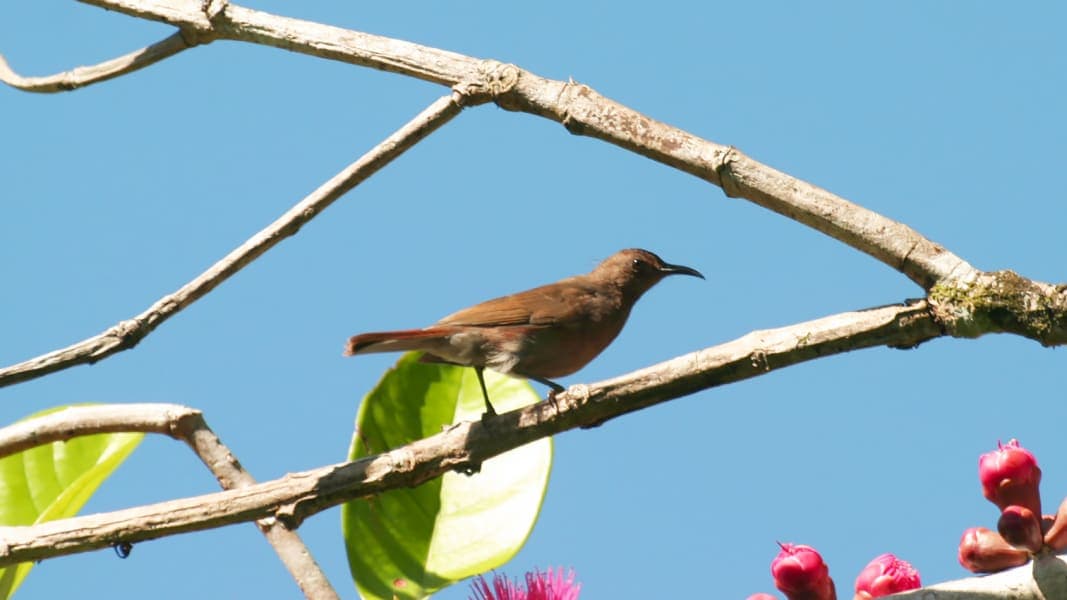
John C. Mittermeier / 18 Dec 2025
Ten years, no independently verifiable documentation. This is the definition that the Search for Lost Birds uses to determine which bird species qualify as ‘lost’ at a global scale. In addition to making it easier to establish which species are lost, this reliance on documentation helps avoid the possibility that misidentifications make a rare and potentially threatened species seem more common than it actually is (as appears to have been the case with the Buff-breasted Buttonquail in Australia).
Built using this documentation-based criterion, the list of lost birds includes species well-known for not having recent records (Crested Shelduck and Jamaican Petrel, for example) along with a few surprises (there have been no documented records of Irrawaddy Broadbill since 1874!). By and large, however, there is congruence between documentation, in particular in the form of photographs, and reported sightings. Species that have recent sightings nearly always also have documentation and species without recent documentation also lack sightings. There are, however, a small handful of exceptions; cases where there have been sightings of a species but no photographs, audio recordings or genetic samples. Until recently, one of these in particular stood out: the Biak Myzomela.
Found only on the islands of Biak and Supiori, off the northwestern coast of New Guinea, this unassuming honeyeater had observations in the past ten years from more than a dozen people on eBird. And yet there was not a single photograph or sound recording of the species. In fact, it seemed like no one had ever photographed the myzomela. Biak Myzomela came out as one of only around 80 birds in the world that we could not find any photographs of.
The result was something unique on the list of lost birds -- an apparently fairly common species, with many sighting reports, but no documentation since 1937 (species like White-eyed River Martin, Eskimo Curlew, and Imperial Woodpecker have all been photographed more recently). What was going on?
In the past few months, the case of the myzomela’s lack of documentation has finally been resolved.
First, Mehd Halaoute, a birding guide who lives in Indonesia and runs Birding Indonesia, shared photographs of the myzomela that he took back in August 2004. The myzomela was not considered a distinct species at the time and Mehd admits that he did not think much of the photographs when he first took them. You can read Mehd’s story about his experiences getting the first-ever photographs of the myzomela below. It is a great example of the value of old, forgotten photographs that you might have sitting on a hard drive somewhere.
More recently, Ethan Skinner posted a photograph of the myzomela from August 2025 on eBird. The Biak Myzomela is now officially both photographed and no longer considered lost.
Thanks to this recent documentation, we can be confident that the myzomela is a case of a bird being overlooked rather than misidentified. So how did this small New Guinean honeyeater end up being one of the last birds on Earth to be photographed and sound recorded?
Taxonomy undoubtedly played a role. The Biak Myzomela spent many years as a subspecies of the widespread Dusky Myzomela, a species many birders are familiar with from northern Australia. It was only recognized as a distinct species in 2016 by BirdLife International and in 2021 by eBird. Birders tend to focus on species, and subspecies are frequently overlooked both when it comes to search effort and to documentation (the Search for Lost Birds is guilty of this as well, only birds recognized as species make the list). So, this taxonomic status likely explains why the myzomela did not receive attention from the birding community until recently.
Appearance and behavior must also have been a factor. Small, dull blackish-brown, and spending its time flitting around in the canopy, the Biak Myzomela does not stand out as a colorful photo target or make itself easy to photograph. There are no recordings of the myzomela to know what it sounds like, but none of its relatives are especially vocal songsters so the myzomela also probably does not lend itself to being easily sound recorded. With several more vocal and visually striking birds sharing the same habitat (such as an endemic lorikeet, pitta, and spectacular paradise-kingfisher), it easy to imagine how visitors to Biak could miss documenting the myzomela, even after it was recognized as a unique species.
While these new photographs of the Biak Myzomela might not generate the attention of rediscovering a long-lost species like the Black-browed Babbler or Black-naped Pheasant-pigeon, the fact that the species represents one of the last remaining gaps between sighting reports and documentation is an exciting milestone. It is also an important reminder of the value of documenting subspecies and not forgetting to photograph and sound record the little brown jobs – they can be just as significant for conservation and science as their flashier relatives!
Now that the myzomela has been photographed, the next question is who will be the first to sound record it?
The First Photographs of Biak Myzomela
By Mehd Halaouate
We had big plans for Biak. It all started in 2001 when we travelled for the first time to Papua. Back then Papua was referred to as Irian Jaya. Our first one-month trip to Indonesia did not include any of Indonesian islands but all the time was spent in Papua. We did see the airport of Jakarta when we landed but just the time needed to transit to a Garuda flight that would see us flying to Jayapura. The feeling was magical when we landed an early morning and gazed at the Cyclops Mountains with admiration.
The plan was to spend two weeks in the Jayapura region followed by a week on Biak and end the trip with a week on Numfor island. The reason for the trip was to experience seeing a number of parrot species in the wild. We were parrot nerds, we are still. This nerdiness developed to founding a bird watching company and at a later stage a foundation for the conservation of parrot species in Indonesia.
Back to the big plan for Biak. Travelling to Papua got us hooked big time, so much so that we started hatching plans to move Indonesia. In 2006, we finally took the leap and I left a well-paid manager job at Volvo Cars company in Gothenburg, Germany, while my ex-wife left her job as a nurse in the same city. We sold our house, car, furniture and many other things and boarded a flight for Indonesia.
We started by moving to Yogyakarta, on Java, while we worked on the planning and legal considerations required for a move to Papua. Biak island was one of our dream locations. We found a spot for potential guesthouse for birdwatchers. It was a piece of land overlooking a beautiful beach with a river on one side, a perfect location. Unfortunately, politics got in the way and in the end, we were unable to secure the necessary permissions and paperwork. The locals we had agreed the project with were both saddened and furious.
While exploring the potential for a guesthouse, I stayed on Biak weeks at a time and got to explore many different areas on the island. I visited Supiori, which I enjoyed very much, and did long days birding around the islands.
I encountered Biak Myzomela on a number of occasions but only photographed it once. Back then the species was still lumped with the Dusky Myzomela in some bird lists. The bird I photographed was next to one of the roads that crosses Biak’s interior feeding on the flowers of a Malayan Apple tree Syzygium malaccense alongside a few parrot species such as Red-cheeked parrots and Biak Lorikeets. To be frank, I was more focused on the parrots. The main reason I decided to photograph the myzomela was to document some of the birds that were feeding in the same tree as the parrots!
To tell you the truth, with all the thousands and thousands of photographs I took all these years especially from Papua I forgot about these of the myzomela until someone asked me if I had seen the species lately. I thought I would look in my hard drives. I went back to 2004 and that is where I found them.
Mehd Halaoute has been birding in eastern Indonesia since 2001 and is the founder and director of Birding Indonesia and Indonesian-based guiding company that leads tours to Bali, the Lesser Sundas, Sulawesi, Papua and the Moluccas, as well as an NGO focused on parrot conservation.